

Remote mines, farms, islands, resorts, telecom sites, industrial facilities, construction camps, logistics hubs, and isolated communities face an energy problem that conventional grid-connected sites do not: the grid cannot always be treated as a stable source of power.
Some locations have no utility connection at all. Others are technically grid-connected but experience limited feeder capacity, voltage disturbances, frequent outages, or long restoration times. In these environments, power reliability can directly affect production, safety, refrigeration, communications, water systems, and other critical operations.

A remote microgrid BESS provides a controllable energy buffer between local generation and site demand. Instead of forcing a diesel generator or weak utility feeder to respond to every second-by-second load change, the battery can absorb excess generation and release stored energy when required.
The U.S. Department of Energy defines remote microgrids as electrically isolated systems that provide local generation, stability, and power-quality services without relying on a larger grid. DOE also notes that microgrids can combine loads, solar PV, batteries, generators, and control systems according to site-specific objectives.
For a project developer, however, the objective is not simply to add a battery. The entire microgrid must be designed around load behavior, renewable generation, generator constraints, critical-load requirements, operating reserve, control philosophy, and expected autonomy.
What Makes a Remote Microgrid Different?
A conventional grid-connected BESS normally has a strong external grid establishing voltage and frequency.
A remote or islanded system may not.
That distinction changes the engineering requirements.
DOE describes a microgrid as a group of loads and distributed energy resources capable of operating together while connected to the utility or independently in islanded mode. In an islanded condition, local resources must supply the loads and maintain a stable electrical system themselves.
For commercial buyers, it is useful to distinguish two operating environments.
Weak-Grid Site
A weak-grid site still has a utility connection, but the connection may have:
- limited available capacity;
- frequent outages;
- unstable voltage;
- long radial feeders;
- restricted import power;
- poor power quality;
- slow restoration after faults.
The BESS may operate grid-connected most of the time while also supporting backup or intentional islanding when required.
Off-Grid Site
An off-grid site has no usable external utility supply.
All electricity must therefore come from local resources such as:
- solar PV;
- wind;
- diesel or gas generators;
- hydro where available;
- battery storage.
In this architecture, maintaining generation-load balance is a continuous operational requirement.

How a Remote Microgrid BESS Works
A typical remote hybrid microgrid may include:
PV + BESS + PCS + Diesel Generator + EMS/Microgrid Controller + Critical and Non-Critical Loads
During strong solar production:
PV → Site Loads → Excess PV → BESS
When solar production decreases:
PV + BESS → Site Loads
During a prolonged renewable-energy deficit:
Generator + BESS → Site Loads
The battery can also support the generator during rapid load increases:
Generator supplies base load + BESS handles transient or peak demand
The EMS continuously determines which resources should operate and how much power each should provide.
This allows the microgrid to treat the battery as more than backup energy. It becomes an operating resource for balancing, renewable-energy utilization, generator optimization, and resilience.
Why Batteries Matter for PV + Diesel Microgrids
Diesel generators are dispatchable, but they are not always efficient or desirable when required to follow highly variable loads.
Consider a remote industrial facility with:
- 700 kW daytime load;
- 1 MWp solar PV;
- 800 kW diesel generator capacity.
At midday, PV may provide most of the site’s electricity. Passing clouds can then cause PV output to fall rapidly. Without storage, generators may need to absorb those changes immediately.
A BESS can act as the short-term balancing resource:
- PV surplus charges the battery;
- rapid PV reduction triggers BESS discharge;
- sudden motor loads can be temporarily supported by the battery;
- generators can operate closer to a planned operating point;
- stored PV can serve evening loads.
A DOE microgrid example similarly illustrates how local PV can reduce the load placed on fossil-fuel generation when an islanded system is operating.
The result is not automatically “diesel elimination.” The achievable reduction depends on solar resource, load profile, battery duration, generator redundancy, seasonal conditions, and the site’s required reliability level.
Can BESS Reduce Diesel Consumption?
Yes, but the economic result must be modeled from the complete operating profile.
An NREL REopt study for a remote Alaska community analyzed wind, battery storage, diesel generation, and electric loads. In one modeled scenario, high renewable penetration reduced fuel use by 54% while reducing energy costs by approximately 21%; a more aggressive fuel-reduction target was technically feasible but was not the most economical option in that study.
The lesson for developers is important:
The technically maximum renewable fraction is not always the economically optimum microgrid.
A commercial model should compare:
- diesel fuel price;
- generator efficiency;
- transportation cost of fuel;
- generator maintenance;
- PV production;
- battery CAPEX;
- battery degradation;
- replacement or augmentation;
- downtime cost;
- required resilience.
At difficult-to-access sites, avoiding generator running hours may also reduce maintenance logistics even when fuel savings alone do not justify the investment.

Grid-Forming BESS vs. Grid-Following BESS
This is one of the most important technical questions for an off-grid or islandable microgrid.
Grid-Following PCS
A grid-following inverter generally synchronizes to an existing voltage and frequency reference.
That reference may come from:
- the utility grid;
- a diesel generator;
- another grid-forming resource.
Grid-following equipment alone should not automatically be assumed to establish an islanded grid.
Grid-Forming PCS
A grid-forming inverter can be designed to establish and regulate the local voltage and frequency reference.
This makes grid-forming capability particularly relevant where the BESS must act as an electrical anchor during islanded operation.
Recent NREL research on the Borrego Springs Microgrid tested a battery inverter upgraded with grid-forming capability to serve as the island leader. Hardware-in-the-loop tests examined transitions between grid-connected and islanded operation and the inverter’s response to load steps while maintaining voltage and frequency.
Sandia’s DOE Energy Storage Program also notes that grid-forming BESS can support functions including black start, transient response, fault ride-through, and critical-load supply, although grid-forming deployments remain a specialized engineering area rather than a feature buyers should assume is present in every PCS.
Therefore, an RFQ should state explicitly whether the project requires:
- grid-following operation only;
- grid-forming operation;
- intentional islanding;
- black start;
- seamless or controlled transfer;
- generator synchronization;
- resynchronization with the utility.
How to Size a Remote Microgrid BESS
Battery sizing should start with the load and operating objective—not with a standard container capacity.
Step 1: Define Critical and Non-Critical Loads
Separate loads into categories such as:
- life-safety loads;
- communication systems;
- production-critical equipment;
- refrigeration;
- water pumping;
- HVAC;
- discretionary loads.
Load shedding can significantly reduce required battery capacity during prolonged outages.
Step 2: Determine Peak Power
The PCS must support the relevant instantaneous demand.
For example:
- critical steady-state load: 350 kW;
- short motor-start or process peak: 500 kW.
The system design must consider both steady-state power and transient capability.
Step 3: Determine Required Energy
A simplified starting calculation is:
Battery energy requirement = Critical load × required battery duration
If the critical load is 300 kW and the battery must support it for two hours:
300 kW × 2 h = 600 kWh AC
Nominal battery capacity must then be higher after considering:
- usable SOC;
- conversion losses;
- degradation;
- reserve;
- temperature;
- end-of-life requirements.
Step 4: Model Renewable Production
For PV-heavy systems, analyze at least hourly—and preferably sub-hourly—production alongside load.
The sizing model should examine:
- average solar conditions;
- winter or low-resource periods;
- cloud transients;
- multiple poor-generation days;
- seasonal load variations.
Step 5: Define Generator Strategy
The battery should be modeled together with generator operating logic.
Questions include:
- At what SOC should the generator start?
- What minimum generator loading is preferred?
- Should the generator charge the BESS?
- How many generators are installed?
- Is N+1 redundancy required?
- Can the battery carry the site while a generator starts?
The resulting battery may be optimized for minutes, hours, or multi-hour renewable shifting depending on the site.
The EMS Is the Microgrid’s Operating Coordinator
A remote microgrid can include excellent hardware and still perform poorly if the control strategy is wrong.
The EMS or microgrid controller typically coordinates:
- PV output;
- battery SOC;
- BESS charging and discharging;
- generator start/stop;
- generator loading;
- grid import where available;
- critical-load priorities;
- reserve SOC;
- alarms;
- forecast-based scheduling.
For example, if the forecast indicates low solar production overnight, the EMS may preserve more SOC during the afternoon rather than maximizing diesel savings immediately.
If tomorrow is expected to have strong solar production, the controller may create enough battery headroom to absorb PV instead of allowing the battery to remain full.
In islanded systems, control behavior should be validated carefully because the microgrid must balance generation and demand locally. DOE’s project-development guidance specifically recommends structured planning, design, procurement, and implementation activities rather than treating a microgrid as a simple equipment purchase.
C&I Cabinet or Containerized BESS?
The correct physical architecture depends primarily on power, energy, environment, transport, and project scope.
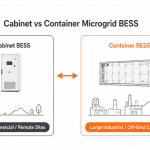
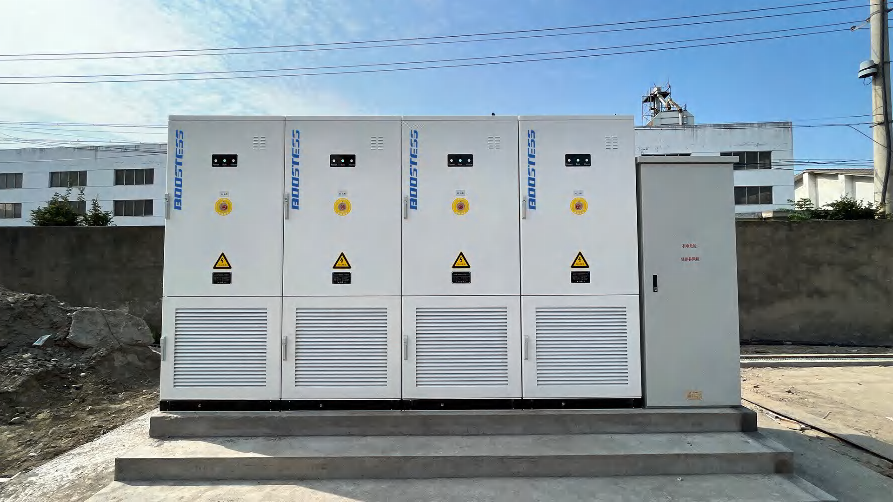
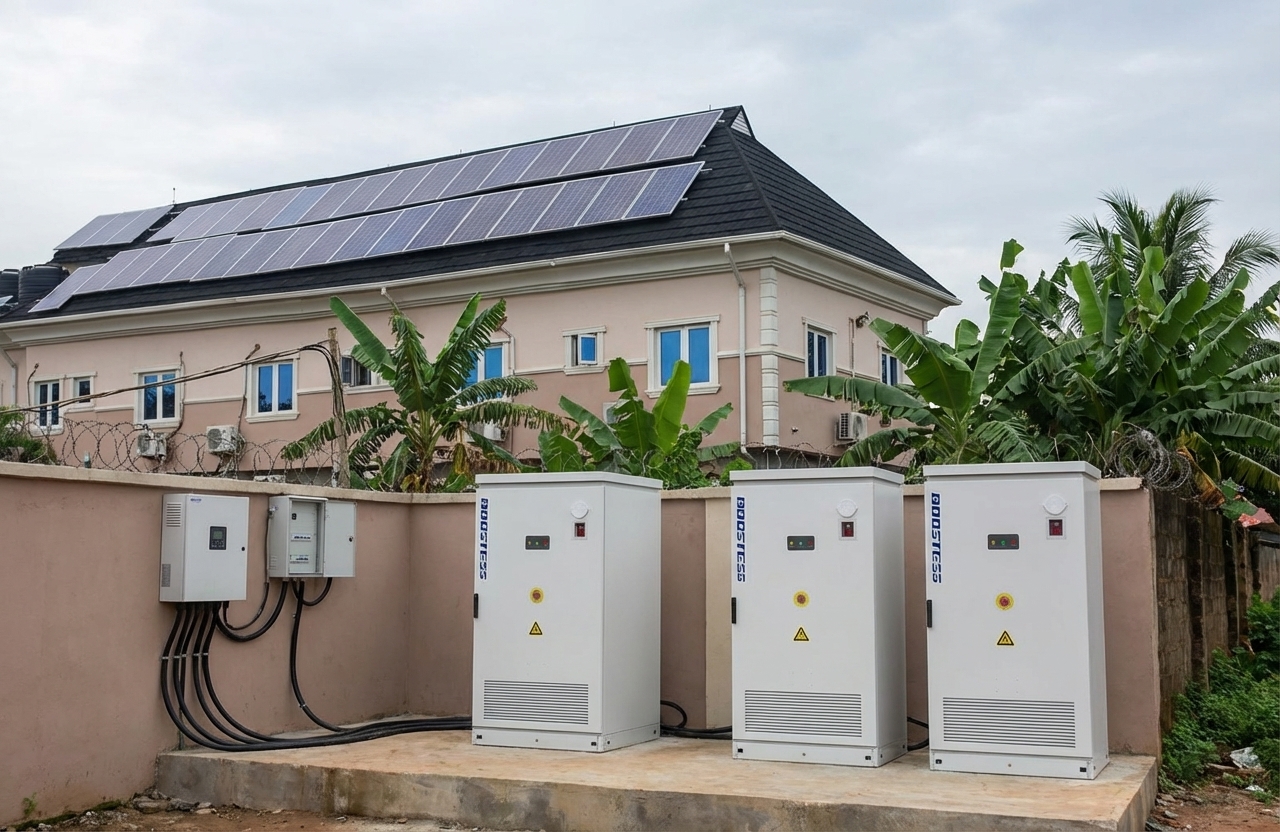
C&I Cabinet BESS
Cabinet systems can fit applications such as:
- remote hotels;
- farms;
- small factories;
- commercial buildings;
- telecom facilities;
- smaller industrial microgrids.
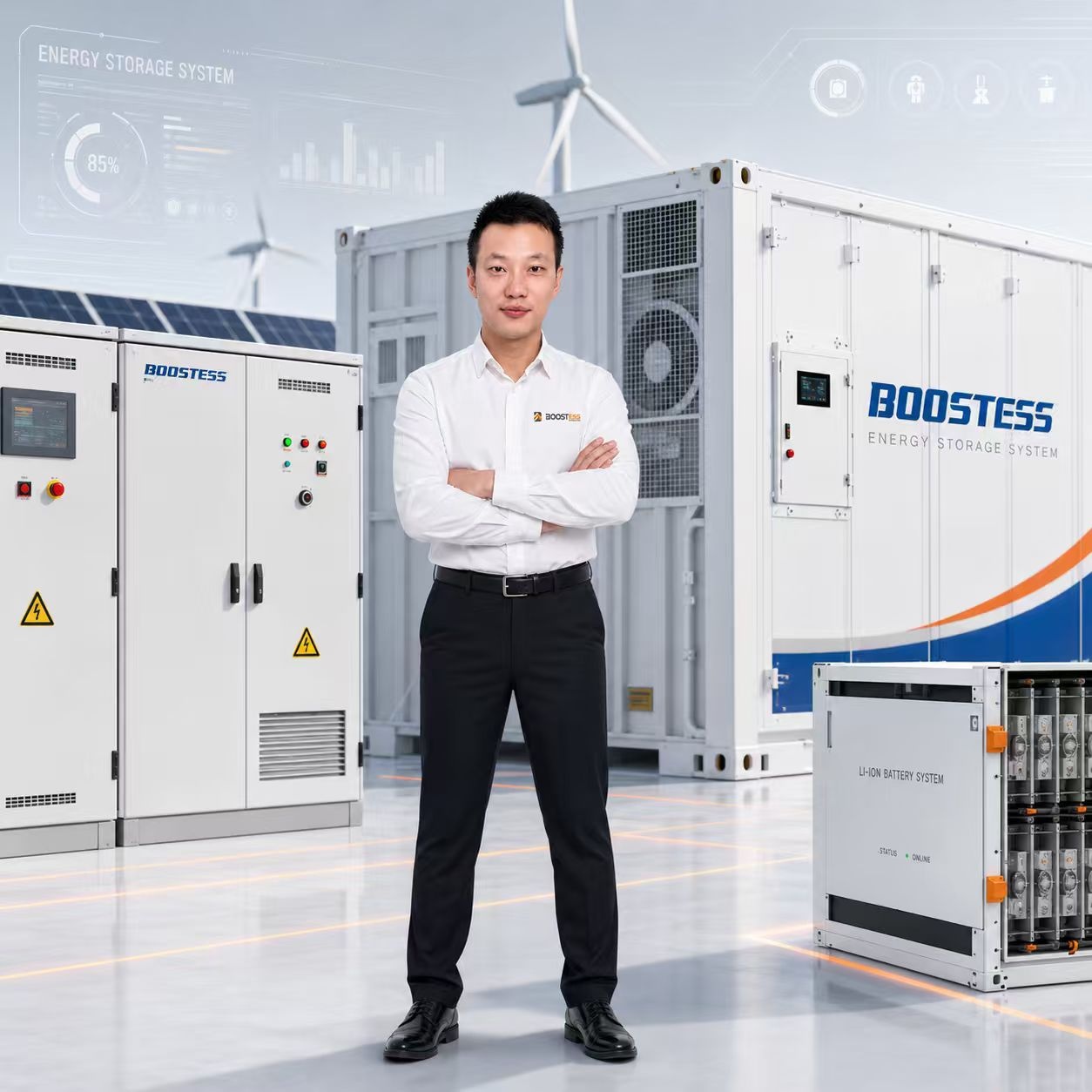
BOOSTESS’s current product portfolio includes 50 kW/100 kWh, 105 kW/241 kWh, and 125 kW/261 kWh C&I cabinet platforms, with published use cases including PV storage, backup, load management, and on/off-grid applications.
Several cabinets may be considered where project-specific parallel operation is supported and confirmed by engineering.
Containerized BESS
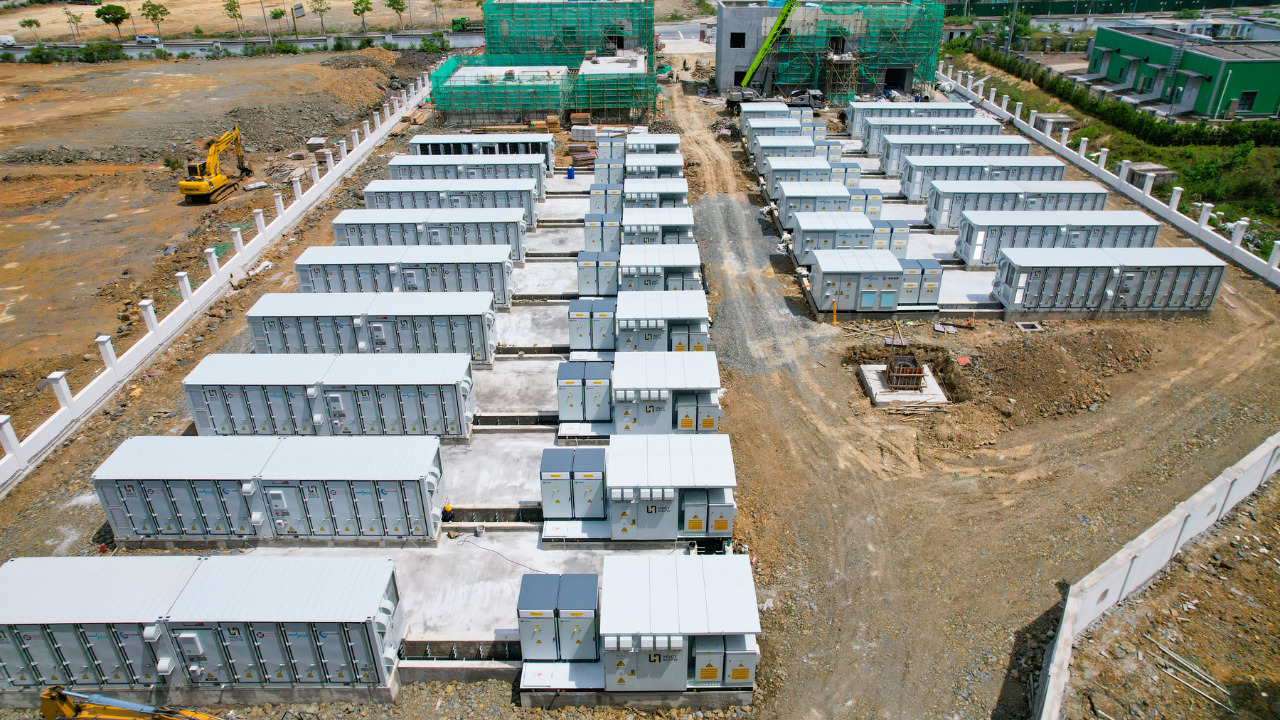
For mining, large industrial sites, islands, campuses, or multi-MWh microgrids, containerized BESS can provide greater energy capacity and modular deployment.
BOOSTESS currently lists 2.17 MWh and 5 MWh liquid-cooled container platforms in its large-scale product portfolio. Its published 2.17 MWh system is specifically positioned for microgrid and off-grid power-supply applications.
Final suitability—including PCS topology, grid-forming behavior, generator interfaces, voltage, certifications, and available parallel configurations—must be confirmed for the specific project.
Safety and Reliability Matter More at Remote Sites
Remote installations can be harder to access, so a fault that would cause a short service interruption at an urban site may create a major operational problem elsewhere.
A remote-microgrid specification should address:
- cell and rack monitoring;
- BMS protection;
- electrical isolation;
- thermal management;
- fire detection and suppression;
- emergency shutdown;
- communications redundancy;
- remote diagnostics;
- spare-parts strategy;
- preventive maintenance;
- local technician capability.
DOE’s BESS procurement checklist recommends defining technical requirements and procurement responsibilities early and points project developers toward dedicated BESS technical specifications and microgrid-development resources.
For remote projects, buyers should also define what happens when communications fail. The microgrid needs safe local fallback behavior rather than depending entirely on cloud connectivity.
Procurement Checklist for Remote Microgrid BESS
Before requesting a formal microgrid proposal, prepare:
Required Input | Why It Matters |
12 months of load data | Defines kW, kWh, seasonal demand |
Critical-load list | Defines resilience requirement |
PV/wind resource profile | Determines renewable contribution |
Existing generator ratings | Defines hybrid operating strategy |
Fuel price and consumption | Supports diesel-reduction economics |
Existing SLD | Defines electrical interfaces |
Grid outage history | Defines weak-grid reliability need |
Required autonomy | Determines energy reserve |
Ambient temperature/altitude | Affects equipment selection |
Site access and logistics | Affects cabinet/container choice |
Grid-forming requirement | Defines PCS/control functionality |
Communications architecture | Defines EMS and remote O&M |
Expansion plan | Prevents premature system constraint |
The proposal should clearly state the responsibility boundary for the battery, PCS, EMS, generator controls, switchgear, transformer, protection, commissioning, and O&M.
Suggested Banner Image Prompt
Create a professional English-language website blog banner for BOOSTESS POWER. Main headline text: “Remote Microgrid BESS: Storage for Weak-Grid and Off-Grid Sites.” Supporting line can reference “remote microgrid BESS” in a concise buyer-friendly way.
Use a realistic remote industrial or community microgrid with solar PV, diesel generator, critical loads, a BOOSTESS-style C&I cabinet BESS and a containerized BESS. Create a clean technical power-flow concept showing PV → BESS → Loads, Generator ↔ Microgrid, and an optional weak utility connection. Visually emphasize uptime, resilience and local power balancing.
Composition: headline left or center-left; project equipment and remote site on the right or lower-right. Use subtle line diagrams, directional energy-flow arrows and a simple local microgrid bus overlay without clutter.
Format: 1300×765 px, 16:9, premium European/US B2B energy style, realistic industrial photography mixed with clean technical graphics, 4K feel. English text only. Helvetica Neue or Roboto, 80 px safe margins, deep blue, white, light gray and subtle tech cyan accents. Include understated BOOSTESS POWER branding.
FAQ
What is a remote microgrid BESS?
A remote microgrid BESS stores and dispatches electricity inside a localized power system to balance renewable generation, generators, utility supply where available, and local loads.
How does a remote microgrid BESS help weak-grid sites?
It can reduce dependence on an unstable feeder, support local loads during disturbances, store local renewable generation, and provide backup or islanded operation when the overall system is designed for those functions.
Can a BESS replace diesel generators completely?
Sometimes, but not automatically. Full diesel replacement depends on load, renewable resource, battery duration, seasonal conditions, redundancy requirements, and acceptable outage risk.
What is grid-forming BESS in a microgrid?
A grid-forming BESS uses a suitably configured inverter to establish or regulate voltage and frequency rather than only following an existing grid reference. This can be important for islanded and off-grid operation.
How large should a remote microgrid battery be?
Size both PCS power in kW and battery energy in kWh using the critical-load profile, peak demand, required autonomy, renewable production, generator strategy, SOC reserve, losses, and degradation.
Is a cabinet or containerized BESS better for remote sites?
Cabinet systems can suit smaller C&I microgrids, while containerized systems are often more practical for multi-MWh industrial or community projects. The final choice depends on capacity, site logistics, environmental conditions, and integration scope.
What information is needed for a microgrid quotation?
Provide load data, critical loads, SLD, PV or wind profile, generator specifications, outage history, required autonomy, environmental conditions, site plan, control requirements, and target project schedule.
 English
  Romanian
  Polish
  German
  Spanish
  Ukrainian
  Hungarian
  Albanian
  French
  Portuguese
  Italian
  Bulgarian
  Croatian
  Czech
Czech  Lithuanian
  Latvian