

For a commercial building owner, installing solar panels is relatively easy to understand: generate electricity on-site and reduce grid purchases. Adding a battery makes the economics more powerful—but also more complex.
A commercial solar battery storage project can store excess photovoltaic generation, reduce peak demand, shift energy into expensive tariff periods and support backup loads. But none of those benefits automatically guarantees an attractive payback.
Two buildings with identical 500 kWp PV arrays can produce completely different battery returns. One may have a large midday PV surplus and high evening electricity prices. Another may consume almost all solar power immediately and have a flat tariff with no meaningful demand charge. The same battery could be economically useful at the first site and oversized at the second.
This is why a bankable solar-storage project starts with tariff and interval data rather than with a cabinet specification.
Interest in distributed solar-plus-storage continues to rise as governments introduce incentives and customers seek greater control over electricity costs. A recent Australian example showed how battery subsidies rapidly increased storage adoption alongside rooftop solar, illustrating how policy can materially change the investment equation. For commercial projects, however, incentives are only one variable. Long-term ROI still depends on how effectively the battery operates against the site’s actual load and tariff.

What Determines Commercial Solar Battery Storage ROI?
The simplest way to think about battery economics is:
Annual battery value = avoided electricity costs + additional solar value + other eligible revenues − operating and degradation costs
Payback is then influenced by the total installed project cost and the annual net value generated by the system.
The major drivers are:
- electricity energy charges;
- demand charges;
- PV surplus;
- battery power in kW;
- usable battery energy in kWh;
- number and timing of cycles;
- round-trip and system losses;
- EMS dispatch logic;
- battery degradation;
- backup reserve;
- incentives or tax treatment;
- maintenance and service costs.
NREL research on commercial buildings found that demand-charge structure is an important predictor of whether a behind-the-meter battery can be economical, while the shape of the building load profile strongly influences the appropriate battery size.
That is why ROI cannot be estimated reliably from annual electricity consumption alone.
1. Electricity Tariffs Can Change the Entire Business Case
Commercial electricity tariffs may contain several components:
- fixed charges;
- energy charges per kWh;
- time-of-use rates;
- peak demand charges per kW;
- seasonal rates;
- export compensation;
- capacity-related charges.
A commercial building paying nearly the same energy price all day has less opportunity for energy arbitrage than one facing a large spread between low-cost and peak-price periods.
Time-of-Use Arbitrage
Suppose a site has excess solar at midday when imported electricity is worth €0.12/kWh, while evening electricity costs €0.28/kWh.
Instead of exporting the midday solar at a low rate, the battery may charge and discharge later, replacing higher-cost grid electricity.
But the economic spread must be large enough to cover:
- conversion losses;
- battery degradation;
- auxiliary consumption;
- operating costs;
- financing cost.
A tariff spread alone therefore does not equal profit.
Demand Charges
In markets where commercial customers pay for their highest grid demand, power capacity can be even more important than stored energy.
NREL notes that commercial demand charges are typically based on peak average demand during a defined interval, often 15 minutes. Battery storage can reduce that peak when dispatched correctly.
For example, if a facility peaks at 520 kW but wants to keep grid import below 400 kW, the battery may need roughly 120 kW of discharge power during the critical period.
The next question is duration.
If the peak lasts 15 minutes, the energy requirement is very different from a three-hour production peak.

2. PV Surplus Determines How Much Solar the Battery Can Actually Capture
A common misunderstanding is that a large PV system automatically creates a strong battery ROI.
The battery needs an economically useful source of charging energy.
For solar self-consumption, calculate:
PV generation − simultaneous building load = potential solar surplus
If a 600 kWp rooftop system produces 450 kW at noon while the building consumes 430 kW, only around 20 kW is available for charging before considering other constraints.
By contrast, if the same PV plant produces 450 kW while the weekend building load falls to 150 kW, there may be roughly 300 kW of surplus generation.
The commercial value then depends on what would otherwise happen to that energy:
- self-consumed later;
- exported at a low tariff;
- curtailed;
- sold at a favorable price.
A good commercial solar battery storage ROI guide must therefore use simultaneous PV and load data, not separate annual totals.
3. Battery Power and Battery Energy Affect ROI Differently
BESS sizing involves two separate variables.
Power Rating: kW
Power determines how quickly the battery can charge or discharge.
It is critical for:
- peak shaving;
- short demand spikes;
- fast PV-surplus absorption;
- backup load support.
Energy Capacity: kWh
Energy determines how long the battery can sustain that output.
It is critical for:
- multi-hour energy shifting;
- evening solar use;
- extended peak-demand events;
- backup duration.
NREL’s commercial-storage work shows that load shape is a key determinant of optimal battery sizing.
Oversizing either dimension can reduce ROI.
A 250 kW / 1,000 kWh battery may offer four hours of duration, but if the building only needs to shave a 30-minute peak, much of that energy capacity may create little additional value.
Conversely, a 50 kW / 500 kWh battery may have plenty of energy but insufficient power to control a 150 kW demand spike.
4. EMS Strategy Often Determines Whether the Modelled ROI Is Achieved
The battery is the energy asset. The EMS decides how the asset is used.
NREL’s REopt framework illustrates this principle by optimizing both system size and dispatch according to site energy consumption and utility rates.
A commercial EMS may coordinate:
- PV forecasts;
- building load;
- electricity tariff;
- battery SOC;
- grid import limits;
- peak-demand targets;
- backup reserve;
- degradation limits.
Consider a site expecting a peak at 5:00 p.m.
If the EMS discharges the battery aggressively at 2:00 p.m. simply because the electricity price rises slightly, the battery may have insufficient SOC remaining for the more valuable 5:00 p.m. demand event.
The technically correct action is not always the economically optimal action.
For solar+BESS projects, the EMS should therefore prioritize competing objectives according to project economics.
5. Solar, Battery and Load Profiles Must Be Modelled Together
Monthly bills are useful for screening, but detailed ROI assessment requires interval data.
A practical study should use:
- at least 12 months of load data;
- 15-minute intervals where available;
- PV generation or production model;
- actual utility tariff;
- operating calendar;
- planned load growth.
NREL used 15-minute interval data together with the applicable utility tariff in a solar-plus-storage optimization study to determine PV/BESS size and dispatch for a California facility.
The analysis should simulate every interval sequentially because battery SOC carries forward through time.
You cannot assume that the battery is always fully charged before every peak.
6. Battery Degradation Must Be Included in the ROI
Every charge-discharge cycle consumes part of the battery’s useful life.
Degradation depends on factors including:
- cycle count;
- depth of discharge;
- SOC operating window;
- temperature;
- charging/discharging rate;
- calendar age.
An ROI model that treats the battery as having identical capacity for 10 or 15 years will generally be too optimistic unless replacement or augmentation assumptions are included.
NREL’s System Advisor Model includes battery temperature, operating conditions and degradation when evaluating storage performance over time.
For procurement, ask suppliers to define:
- beginning-of-life usable capacity;
- end-of-life capacity assumption;
- operating SOC range;
- degradation basis;
- cycle assumptions;
- warranty throughput conditions.
Do not compare battery proposals only on nominal kWh.
7. Backup Reserve Can Reduce the Energy Available for ROI
Many building owners want one battery to provide both electricity savings and emergency backup.
That is technically possible, but capacity reserved for backup cannot always be used simultaneously for arbitrage or peak shaving.
Suppose the operating policy requires at least 30% SOC for emergency loads.
Only the remaining operating window may be available for daily optimization.
This creates a commercial decision:
How much battery capacity should be reserved for resilience versus revenue?
NREL studies of commercial solar-plus-storage have shown that assigning financial value to resilience can materially change the optimal system design and economics.
For hospitals, data centers, hotels or critical commercial buildings, avoiding an outage may justify reserve capacity even if simple bill-savings payback becomes longer.
8. Incentives Can Improve Payback—but Should Not Hide Weak Fundamentals
Subsidies, grants, tax incentives and financing programs can reduce upfront CAPEX and shorten apparent payback.
The 2026 Australian battery program provides a clear example of this effect: Reuters reported that expanded subsidies triggered a rapid increase in battery installations and encouraged additional solar adoption.
Commercial buyers should still model two scenarios:
Base case: project economics without incentive support.
Supported case: economics after grants, subsidies or tax benefits.
This shows whether the project has strong operational value or relies heavily on policy support.
Local incentive eligibility, tax treatment and electricity-market rules should always be confirmed with qualified local advisers.
9. A Simple Commercial Solar Battery ROI Example
Consider an illustrative commercial building.
Site assumptions
- PV system: 500 kWp
- Peak building demand: 430 kW
- Target peak: 300 kW
- Candidate BESS: approximately 125 kW / 261 kWh
- Main uses: PV self-consumption + peak shaving
- Operating days: 300 per year
Assume the simulation estimates:
- €15,000/year from increased solar self-consumption;
- €18,000/year from demand reduction;
- €5,000/year from tariff shifting.
Gross annual value:
€38,000
Assume annual allowances for maintenance, auxiliary energy and degradation-related economic cost total €7,000.
Indicative net annual value:
€31,000
If the total installed project investment were hypothetically €200,000 after applicable support:
Simple payback ≈ €200,000 ÷ €31,000 = 6.5 years
This is only an illustrative calculation—not a BOOSTESS price or ROI guarantee.
A complete financial analysis should also consider:
- financing;
- inflation;
- electricity-price escalation;
- degradation;
- battery replacement;
- taxes;
- residual value;
- discount rate.
For investment decisions, NPV and IRR are usually more informative than simple payback alone.
10. Where a C&I Cabinet BESS + EMS Fits
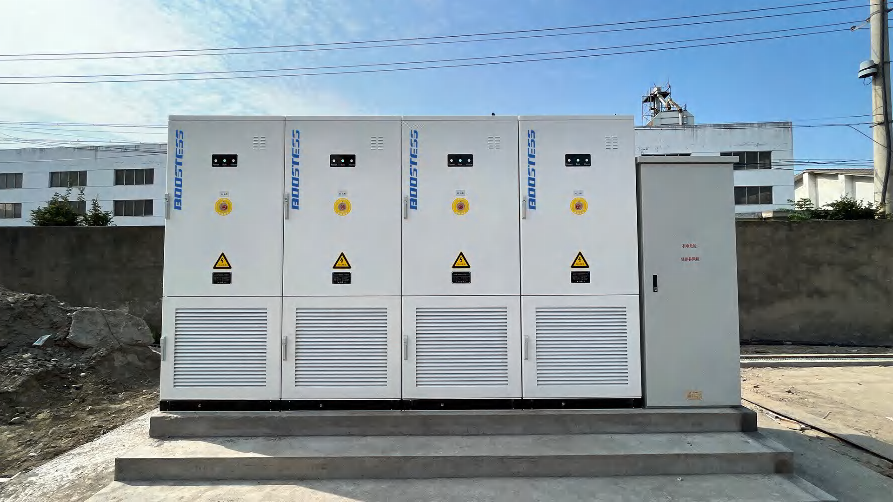
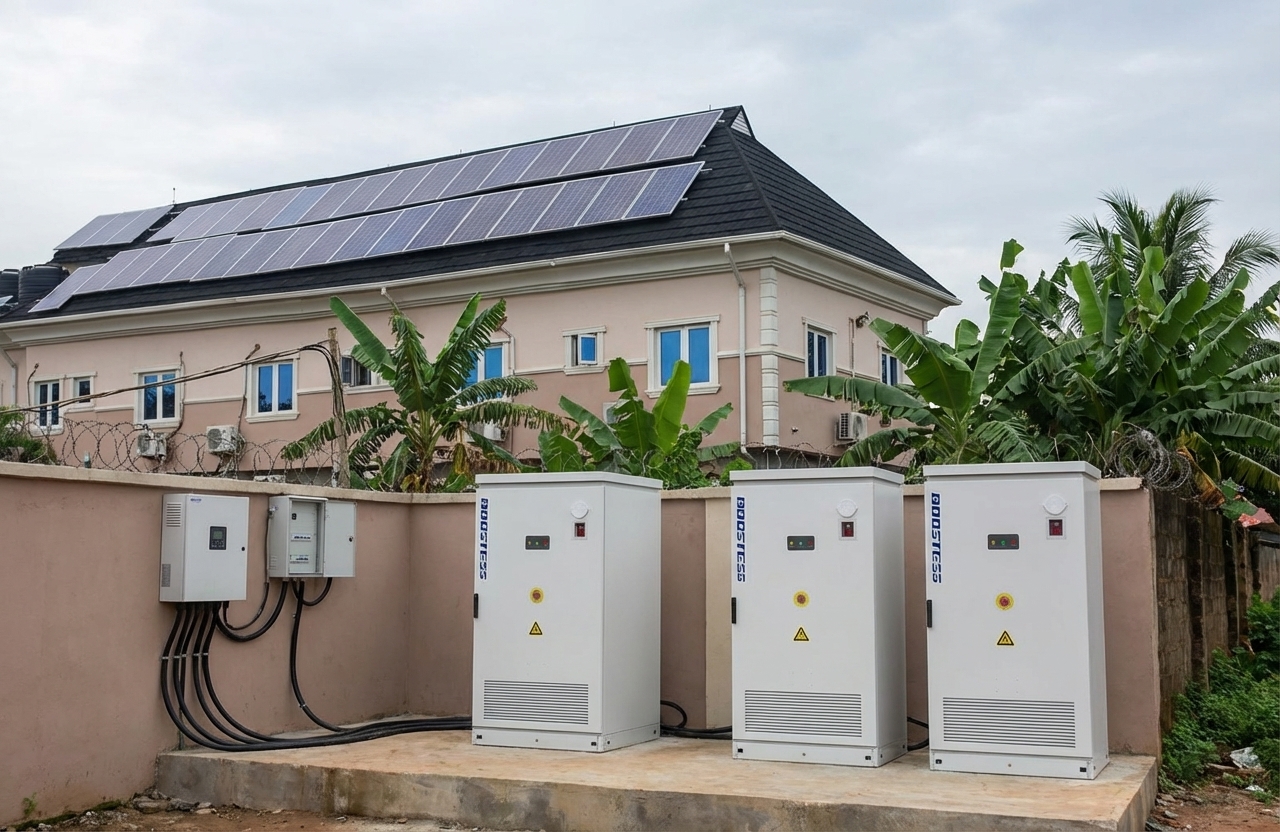
Commercial buildings often benefit from compact cabinet-type systems because the battery, PCS, thermal management, BMS and controls can be integrated into a relatively standardized project package.
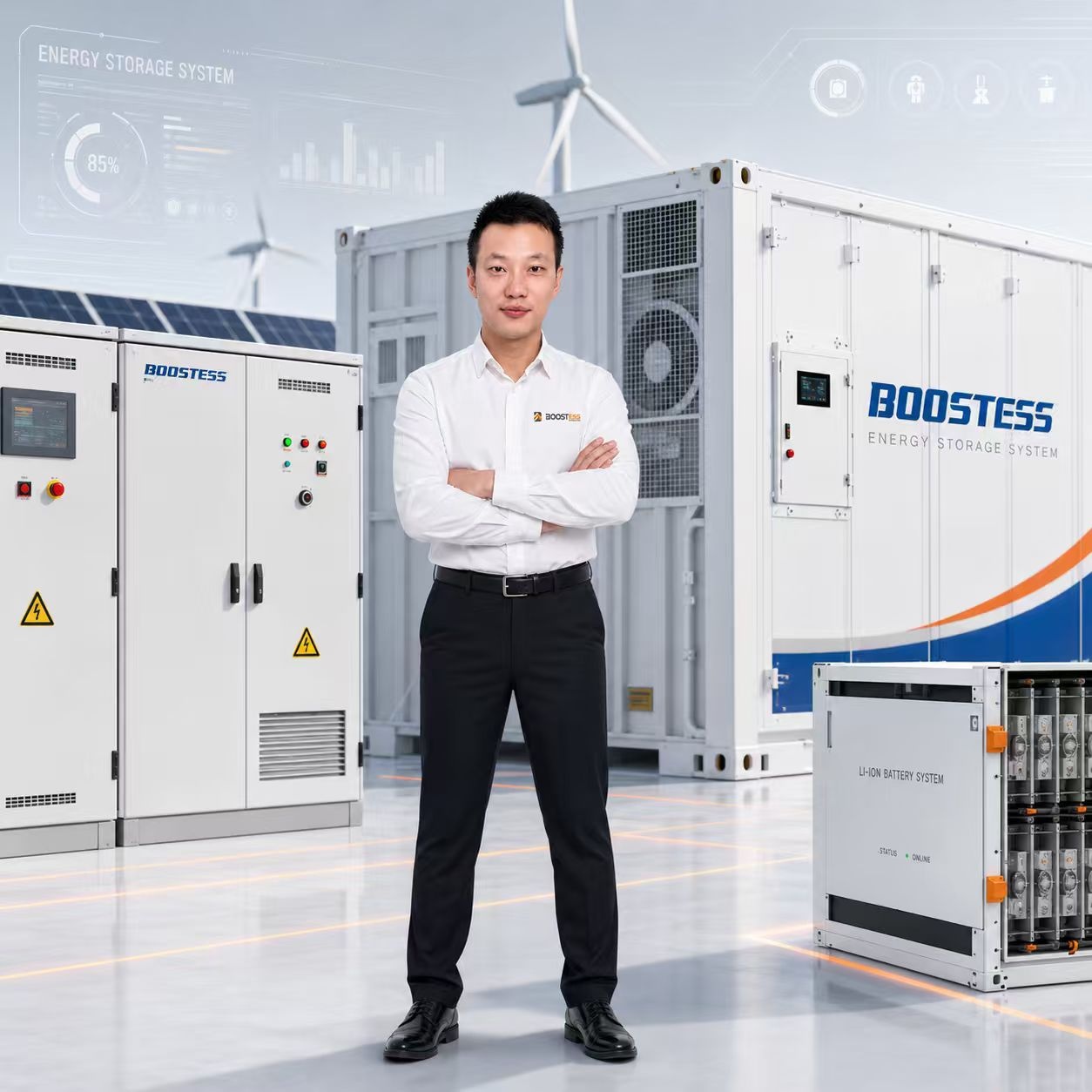
BOOSTESS currently lists a 125 kW / 261 kWh liquid-cooled C&I Energy Cube with integrated PCS and EMS/BMS functions. Its published applications include commercial and industrial peak shaving, PV energy storage and backup applications.
For a commercial building, an integrated cabinet can reduce the number of separate interfaces compared with assembling the battery and conversion system from unrelated components.
However, product selection must still follow the site study.
A 125 kW / 261 kWh cabinet is not automatically correct simply because the site is commercial.
The engineering team still needs to confirm:
- peak reduction target;
- load duration;
- PV surplus;
- system voltage;
- operating environment;
- number of parallel cabinets;
- grid requirements;
- backup demand;
- EMS strategy.
The final configuration should be based on project data and the signed technical specification.

Procurement Checklist Before Requesting an ROI Assessment
Before approaching a BESS supplier, prepare:
- 12 months of 15-minute electricity data;
- at least 12 recent utility bills;
- complete tariff structure;
- PV capacity and generation profile;
- export tariff;
- demand-charge structure;
- building operating hours;
- future load growth;
- EV charging or electrification plans;
- backup requirements;
- SLD and transformer capacity;
- available installation area;
- target investment horizon.
Then request the ROI model to state all assumptions explicitly.
A credible proposal should explain what percentage of savings comes from solar self-consumption, peak reduction and tariff shifting instead of presenting only one headline payback number.
FAQ
What affects commercial solar battery storage ROI the most?
The main factors are electricity tariffs, demand charges, PV surplus, building load profile, battery size, EMS dispatch strategy, degradation, installed cost and available incentives.
What is a good payback period for commercial solar battery storage?
There is no universal target. Acceptable payback depends on project life, financing cost, business risk, electricity prices, resilience value and the owner’s required investment return.
Does adding a larger battery always improve ROI?
No. Oversizing increases CAPEX and may leave battery capacity underused. The optimal kW and kWh should be determined from interval load, PV and tariff data.
How does EMS improve commercial solar battery storage ROI?
EMS schedules charging and discharging around PV surplus, peak demand, tariffs, SOC limits and operating priorities so the battery is available for the highest-value events.
Are demand charges important for battery payback?
They can be highly important where the tariff includes significant peak-demand charges. The economic impact depends on the site’s load profile and the exact utility tariff.
Can commercial solar battery storage provide backup and still earn revenue?
Yes, but energy reserved for backup reduces the capacity available for daily optimization. The ROI model should explicitly define the reserve SOC.
What data is needed for a commercial solar battery storage ROI assessment?
Provide 12 months of interval load data, electricity bills, tariff information, PV production, export limits, building operating schedule, backup requirements and planned load growth.


 English
  Romanian
  Polish
  German
  Spanish
  Ukrainian
  Hungarian
  Albanian
  French
  Portuguese
  Italian
  Bulgarian
  Croatian
  Czech
Czech  Lithuanian
  Latvian