

For factories, warehouses, logistics parks, hotels, office buildings and EV charging sites, electricity cost is not always determined only by how many kilowatt-hours are consumed.
In many commercial tariffs, part of the bill is linked to the facility’s highest measured demand in kilowatts during a billing period. A short production surge, several large motors starting together, a cooling load increase or simultaneous EV charging can therefore create a costly demand peak even if the event lasts only a short time.
This is the commercial logic behind BESS peak shaving.
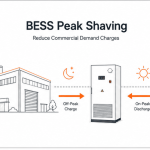
A battery energy storage system charges when facility demand is lower and discharges when demand approaches a predefined limit. From the utility meter’s perspective, the BESS supplies part of the facility load, reducing the amount of power drawn from the grid during the critical interval.
NREL explains that many commercial demand charges are based on the highest average electricity demand measured within a defined interval—often 15 minutes—and identifies peak-demand management as an important behind-the-meter battery use case.
The technology is straightforward in principle. The difficult part is determining the correct battery power, energy capacity and EMS strategy so the system reduces the peaks that actually matter financially.

How BESS Peak Shaving Works
Consider a factory with a grid-demand target of 500 kW.
During most of the day, facility demand remains between 300 and 450 kW. At 3:30 p.m., several production lines and cooling systems operate simultaneously and total demand reaches 650 kW.
Without storage:
Grid demand = 650 kW
With a BESS providing 150 kW:
650 kW facility load − 150 kW BESS discharge = 500 kW grid demand
The battery effectively “shaves” the part of the load above the target.
Later, when facility demand falls, the BESS can recharge.
The basic operating sequence is:
Low-demand period → BESS charges → Load approaches target → EMS commands discharge → BESS supplies part of load → Grid peak is limited
Research and commercial modeling tools consistently treat this dispatch timing as central to successful peak shaving. NREL’s System Advisor Model, for example, includes behind-the-meter dispatch specifically designed to reduce demand charges by coordinating battery discharge with peak facility load.
Why Demand Charges Make Short Peaks Expensive
Energy charges and demand charges measure different things.
An energy charge is based on consumption:
kWh = how much electricity was used over time
A demand charge is based on power:
kW = how much electricity was required at a particular time
A facility may therefore have relatively moderate total energy use but still incur a significant bill if it creates a very high short-duration peak.
NREL notes that demand charges are commonly based on the highest average usage during a utility-defined demand interval. The exact tariff structure varies by utility and jurisdiction, so buyers must use their actual tariff rather than relying on a generic demand-charge assumption.
This is why BESS peak shaving for commercial buildings is fundamentally a data-analysis problem.
The battery should target the demand intervals that determine the bill—not simply discharge whenever facility load appears high.
Start With the Load Profile, Not the Battery Cabinet
One of the most common procurement mistakes is asking:
“Which battery should I buy for a 1 MW factory?”
Installed transformer capacity or annual electricity use is not enough to answer that question.
A proper peak-shaving study should begin with interval-meter data.
Ideally, provide:
- at least 12 months of facility load data;
- 15-minute intervals where available;
- electricity bills;
- complete tariff structure;
- production schedules;
- existing PV generation;
- planned EV charging or new equipment;
- transformer and grid limits.
The load profile should then be examined for:
- maximum demand;
- time of peak;
- frequency of peaks;
- peak duration;
- seasonal variation;
- weekday/weekend differences;
- repeated peaks within the same day.
A single short spike and a three-hour plateau may reach the same maximum kW, but they require very different battery energy capacities.

Power Sizing: How Many kW Does the BESS Need?
Battery power determines how much load the system can offset at any instant.
A simplified screening equation is:
Required BESS power = Facility demand − Target grid demand
Assume:
- maximum facility demand: 720 kW;
- target grid demand: 550 kW.
Then:
720 − 550 = 170 kW
A preliminary study would therefore need to evaluate approximately 170 kW of discharge capability.
But this is not yet a final PCS rating.
The engineering team may also need to consider:
- PCS operating limits;
- reactive power requirements;
- temperature and altitude derating;
- transformer limits;
- future load growth;
- auxiliary consumption;
- redundancy;
- grid-code requirements.
The target itself must also make economic sense. Attempting to eliminate the highest 1% of rare peaks may require substantially more battery power than controlling the more frequent demand range.
Energy Sizing: How Many kWh Are Needed?
Power tells you how hard the battery must work.
Energy tells you how long it must work.
Suppose the required BESS discharge during four consecutive 15-minute intervals is:
Interval | Facility Load | Grid Target | BESS Output |
14:00–14:15 | 590 kW | 500 kW | 90 kW |
14:15–14:30 | 640 kW | 500 kW | 140 kW |
14:30–14:45 | 610 kW | 500 kW | 110 kW |
14:45–15:00 | 550 kW | 500 kW | 50 kW |
Each interval lasts 0.25 hour.
Required AC discharge energy is approximately:
(90 + 140 + 110 + 50) × 0.25 = 97.5 kWh
That does not mean a 97.5 kWh nominal battery is sufficient.
The design must also account for:
- usable SOC range;
- conversion losses;
- battery degradation;
- backup reserve;
- repeated peaks;
- recharge opportunities;
- end-of-life capacity.
This distinction between kW and kWh is critical. A battery can have enough energy but insufficient power—or sufficient power but insufficient duration.

Why the EMS Is Critical to BESS Peak Shaving
The battery stores energy. The EMS decides when that energy should be used.
A poor control strategy can substantially reduce peak-shaving value.
Imagine the facility normally peaks around 5:00 p.m., but the EMS begins discharging heavily at 2:00 p.m. when demand rises only moderately. By 5:00 p.m., battery SOC may be too low to control the true billing peak.
The result is technically successful discharge but commercially unsuccessful dispatch.
A 2026 experimental study of behind-the-meter BESS control evaluated coordinated PV self-consumption, peak-load reduction and grid services using a 264 kWh / 140 kW battery at a commercial building with approximately 300 kW peak demand. The study demonstrates why real-time load, battery SOC and service priorities must be coordinated instead of treating battery capacity as permanently available for one purpose.
For peak shaving, the EMS should typically monitor:
- real-time facility demand;
- target grid-import threshold;
- battery SOC;
- forecast load;
- electricity tariff;
- PV generation;
- charging opportunities;
- battery operating constraints.
Control set-points matter as well. NREL research has found that poorly selected peak-shaving control triggers can leave BESS capacity underutilized.
Peak Shaving vs. Energy Arbitrage
These two use cases are often confused.
Peak shaving reduces maximum kW demand.
Energy arbitrage shifts kWh from lower-price periods to higher-price periods.
A BESS can potentially do both.
For example:
- charge overnight at a lower tariff;
- reserve enough SOC for the afternoon demand peak;
- discharge only when grid demand exceeds the target;
- use remaining battery capacity for tariff optimization.
But the same battery capacity cannot always serve every use case simultaneously.
If energy arbitrage consumes too much SOC before the facility peak, demand savings may be lost.
This is why commercial projects need a clear EMS priority hierarchy rather than separate theoretical savings calculations that assume the full battery is available for every service.
How PV Changes Peak-Shaving Strategy
Commercial solar can reduce daytime grid demand, but PV does not necessarily eliminate demand peaks.
A factory may experience its maximum demand:
- before sunrise;
- after sunset;
- during cloudy periods;
- when production load rises faster than PV output;
- during simultaneous equipment operation.
The EMS should therefore evaluate net load:
Net load = Facility demand − PV generation
The BESS then responds to the remaining grid demand.
This architecture can create useful combinations:
PV → building load → BESS charging when surplus exists
and later:
PV + BESS → building load → reduced grid import
The economic benefit depends on the actual facility load and PV profile rather than installed solar capacity alone.
A Practical C&I Peak-Shaving Example
Consider an illustrative industrial facility.
Assumptions:
- normal grid demand: 350–450 kW;
- recurring peak: 600 kW;
- desired demand limit: 480 kW;
- peak duration: approximately 60–90 minutes;
- existing rooftop PV: 300 kWp.
Maximum required battery discharge:
600 − 480 = 120 kW
Assume interval analysis shows approximately 150 kWh of usable AC energy is required to manage the complete peak event.
After allowing for operating SOC, losses, degradation and reserve, the engineering team may screen a system in roughly the 125 kW / 250+ kWh class.
This is where an integrated C&I cabinet may become relevant.
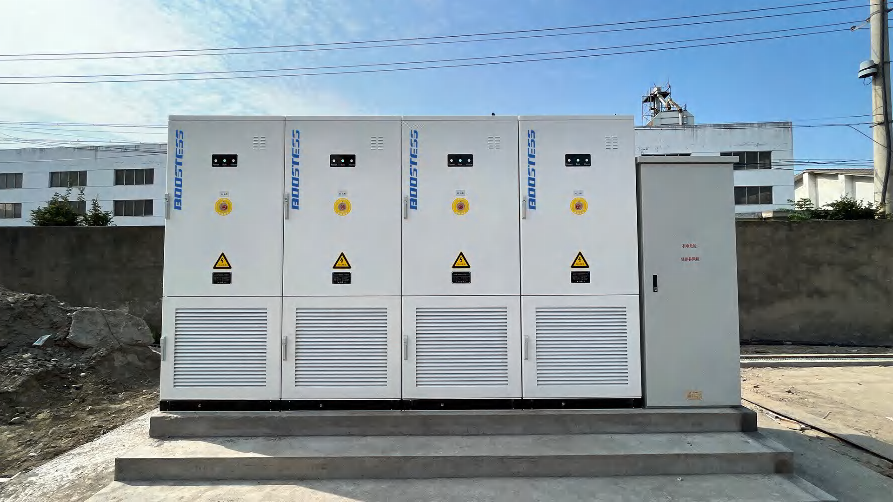
BOOSTESS currently lists a 125 kW / 261 kWh liquid-cooled Energy Cube with integrated PCS, BMS and EMS functionality, and the published product positioning specifically includes industrial peak shaving and load management.
BOOSTESS also publishes a 105 kW / 241 kWh air-cooled C&I cabinet positioned for industrial-park peak shaving and commercial applications.
These published ratings are useful for initial screening, but final suitability depends on the actual load profile, voltage, tariff, environmental conditions, operating reserve and project-specific technical agreement.
When Liquid Cooling or Air Cooling Makes Sense
Cooling architecture should not be selected from marketing preference alone.
Air-cooled cabinets may be appropriate where:
- duty cycles are moderate;
- ambient conditions are suitable;
- simpler thermal architecture is preferred;
- cost sensitivity is high.
Liquid-cooled systems may be considered where:
- cycling is more intensive;
- tighter temperature control is required;
- compact energy density matters;
- ambient operating conditions are demanding.
BOOSTESS currently offers both air-cooled and liquid-cooled C&I cabinet platforms in its commercial product range.
The correct choice should reflect duty cycle, climate, expected throughput, maintenance strategy and project economics.
What Determines Peak-Shaving Savings?
The largest savings do not necessarily come from the largest battery.
A credible savings estimate should evaluate:
1. Actual Demand-Charge Structure
The tariff must identify:
- demand-charge rate;
- billing interval;
- seasonal variation;
- peak-period rules;
- ratchets or contract-demand mechanisms.
2. Achievable Peak Reduction
Not every monthly peak can necessarily be reduced to the same target.
Load variability matters.
3. Battery Availability
Peak events must occur when the battery has sufficient SOC and discharge power available.
4. Degradation
Daily cycling gradually affects available battery capacity. NREL’s SAM storage model includes operating-condition and degradation effects when modeling long-term storage performance.
5. Operating Costs
The financial model should include:
- efficiency losses;
- auxiliaries;
- maintenance;
- service costs;
- replacement assumptions where relevant.
This is why a supplier should not promise a universal percentage reduction in electricity bills.
Procurement Checklist for a Peak-Shaving BESS
Before requesting a formal quotation, send the supplier:
- 12 months of 15-minute load data;
- recent electricity bills;
- complete tariff sheet;
- desired grid-demand limit;
- existing PV data;
- single-line diagram;
- transformer capacity;
- grid voltage;
- site temperature and altitude;
- installation area;
- required backup reserve;
- expected expansion;
- commissioning scope;
- EMS communication requirements.
Ask the proposal to state:
- BESS rated kW;
- nominal and usable kWh;
- assumed SOC range;
- efficiency boundary;
- degradation assumption;
- peak-shaving logic;
- number of cabinets;
- recharge strategy;
- equipment and service scope.
This turns a cabinet quotation into an engineering proposal.
FAQ
What is BESS peak shaving?
BESS peak shaving uses battery storage to supply part of a facility’s load during high-demand periods, reducing the maximum power drawn from the grid and potentially lowering demand charges.
How does BESS peak shaving reduce commercial electricity bills?
The battery discharges when grid demand approaches a predefined limit. If the utility bills customers based on peak kW demand, reducing that measured peak can lower the demand-charge portion of the bill.
How do you size a BESS for peak shaving?
Determine the maximum kW above the target demand limit and calculate the kWh required across each peak event. Then adjust for SOC limits, efficiency, degradation, reserve and future load.
Is 15-minute load data necessary for BESS peak shaving?
It is strongly preferred when the tariff uses 15-minute demand intervals because it reveals the magnitude, timing and duration of the peaks that may determine the bill.
Can a BESS perform peak shaving and energy arbitrage at the same time?
Yes, if the EMS coordinates battery capacity between both objectives. The dispatch strategy must preserve enough SOC and power for the highest-value demand peaks.
Can solar and BESS peak shaving work together?
Yes. PV first reduces the facility’s net grid load, while the BESS can address remaining demand peaks or store surplus solar energy for later use.
Which C&I BESS is suitable for peak shaving?
The correct system depends on required kW, kWh, peak duration and site conditions. Integrated C&I cabinets such as BOOSTESS’s published 105 kW / 241 kWh and 125 kW / 261 kWh platforms can be screened for suitable commercial and industrial projects, subject to engineering review.

 English
  Romanian
  Polish
  German
  Spanish
  Ukrainian
  Hungarian
  Albanian
  French
  Portuguese
  Italian
  Bulgarian
  Croatian
  Czech
Czech  Lithuanian
  Latvian